
PV yield assessment for photovoltaic systems
Energy yield assessments and yield forecasts for ground-mounted and rooftop PV systems, with and without storage, simulated with PVsyst – as a basis for planning, financing, and purchase and sale.
Background
The planning and financing of a solar power system require a reliable statement of its yield, one that is accepted by banks and investors as well as by technical advisors.
The yield assessment determines the expected amount of energy from the photovoltaic system on the basis of the site conditions and the planned components, and presents it in a traceable way. We prepare yield assessments for planned and existing systems.
| Reason | Question |
|---|---|
| Planning | What yield can be expected with the chosen layout and the chosen components? |
| Financing | Which yields can the bank or investor use as the basis for the economic calculation? |
| Purchase and sale | What yield is the system likely to deliver over its operating life? |
| Review | Is an existing yield assessment by another author plausible? |
Contents of a yield assessment
A yield assessment comprises:
Irradiation at the site
Evaluation of site-specific irradiation and temperature values from several sources and selection of a suitable data set.
Simulation of the system yield
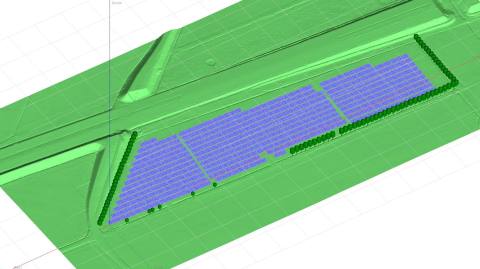
Yield simulation with PVsyst in a 3D scene of the system with terrain, horizon and shading objects.
Performance ratio
Determination of the performance ratio (PR), the ratio of actual to theoretically possible yield.
Loss analysis
Detailed breakdown of the losses, for example due to shading, temperature, cabling and inverters.
Evaluation of the results
Interpretation of the results and of the assumptions used; on request with a conservative and an optimistic approach.
Financing requirements
On request, probabilities of reaching certain yields and performance ratios within a defined period.
Weather data and irradiation
For the yield simulation, the estimate of future irradiation and temperatures is of particular importance. We determine long-term monthly mean values of irradiation and temperature for the last 10 to 20 years from various sources, compare and evaluate them, and select a suitable data set.
It is assumed that irradiation and temperature remain the same over the operating life of the PV system; deviations are included in the uncertainty of the results. In addition to the chosen forecast, a more conservative or a more optimistic approach can be presented.
Yield simulation with PVsyst
We prepare yield simulations with the current version of PVsyst. Design files, for example from Helios 3D or PVcase, can be imported. A detailed 3D scene of the system is created for every simulation.
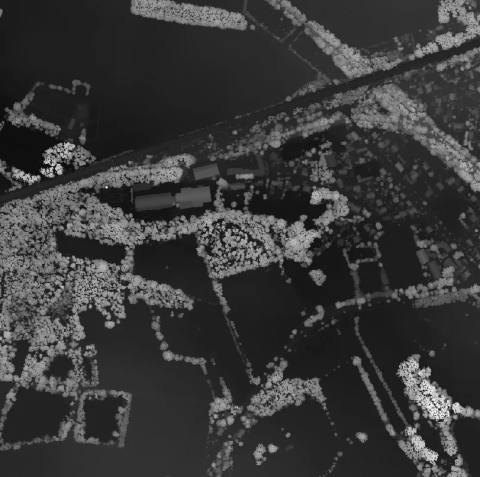
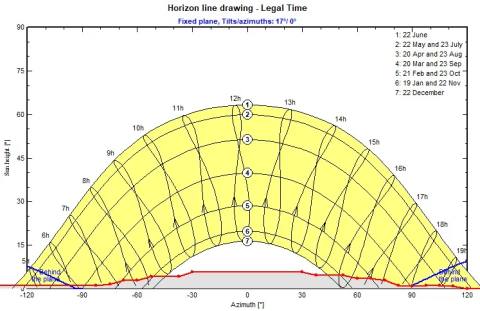
We determine local conditions and shading ourselves: the height of trees, buildings and other shading objects is derived from a digital surface model, and shading by the surrounding terrain from the horizon line. A site visit is usually not necessary for this, but is carried out on request.
Yield forecast or yield assessment
| Criterion | Yield forecast | Yield assessment |
|---|---|---|
| Purpose | compare variants, optimise yield or land use | reliable basis for financing, purchase and sale |
| Timing | already at an early planning stage | useful from a preliminary design ready for permitting; can be adapted to the final design with little effort |
| Result | summary or simulation report | expert report with weather data, loss analysis, performance ratio and evaluation |
| Assumptions | assumptions on losses and components, adjustable for comparing variants | assumptions and data sources evaluated and stated |
Further services
Revenue assessment for battery storage
A yield assessment determines the amount of energy from a PV system. It does not apply to a battery storage system, as this does not generate energy; what matters there are price differences and ancillary services. The revenues are assessed in the revenue assessment.
Review of existing assessments
Review of an existing yield assessment by another author, for example before financing or purchase.
Technical due diligence
Technical review of systems and portfolios before acquisition, up to the system documentation: technical due diligence.
Frequently asked questions
What is a yield assessment for photovoltaics?
A PV yield assessment determines the expected amount of energy from a photovoltaic system. It is based on the meteorological conditions at the site, irradiation, topography, terrain and shading, and on the planned components. The assessment states the specific yield, the performance ratio and the losses, and evaluates the results.
What is a PV yield assessment needed for?
For the planning and financing of a PV system: banks, investors and technical advisors need reliable figures on the yield in order to judge its economic viability. A yield assessment is also needed later, for example when a system is bought or sold, or to review an existing assessment by another author.
What is the difference between a yield forecast and a yield assessment?
A yield forecast simulates the yield of a design with the main components, the layout, tilt and orientation of the modules and assumptions about the losses. The results are presented briefly or as a simulation report; an expert report is not usually prepared. It is suited to comparing variants and to optimising yield or land use. The yield assessment additionally evaluates weather data, losses and results and serves as a basis for financing and purchase.
Are the yield assessments recognised by banks?
Yes. We are on the approved expert lists of many banks; our yield assessments serve as a basis for financing. If the lender requires particular values, such as probabilities of reaching certain yields and performance ratios within a defined period, we determine these and state them in the assessment.
Are yield assessments also available for PV power plants and solar parks?
Yes. We prepare yield assessments for ground-mounted systems and PV power plants as well as for rooftop systems, for planned and existing systems, with and without storage. Design files from Helios 3D or PVcase can be imported.
How much does a yield assessment cost?
Costs depend on scope and question; you receive a quote in advance.
How long does a yield assessment take?
Usually two to three weeks after receipt of complete documents. If it is urgent, please contact us.
What documents are needed as a minimum for a yield assessment?
As a minimum, the site of the system and the layout and orientation of the modules. Module type and number as well as inverter type and number should be specified. Depending on the project, ground-mounted or rooftop, further details on the arrangement of the modules on the mounting structure are required. Missing details can be replaced by assumptions, which are stated in the assessment.
Does a yield assessment also apply to battery storage?
No. A battery storage system does not generate energy; it absorbs it and releases it again. What matters there are price differences and ancillary services; these are assessed in the revenue assessment.
Are yield assessments also prepared in English?
Yes, we prepare yield assessments in German and in English.
Enquiry
Use the form, call us on +49 4103 121 4221 or write to kontakt@sonnwinn.de – whichever suits you best.
You do not need to attach documents to your enquiry – once we have received it, we will help you put together the documents required.
Which documents are helpful
- Site of the system
- Layout, tilt and orientation of the modules (module layout plan), for ground-mounted systems with details of the mounting structure
- Module type and number, inverter type and number
- If available: design file, for example from Helios 3D or PVcase
- If required: the bank's or investor's requirements for the assessment